
Car and Air-Care Fragrance Lead Times: Where the Weeks Actually Go
A car or air-care fragrance project usually takes longer than a perfume project of the same value, and almost none of the extra time is spent on the scent. It goes into the delivery system: compatibility testing against plastics and coatings, thermal ageing, leak and transport checks, and the housing that carries the product. Teams that plan for a perfume timeline and receive an air-care one lose a quarter. The fix is simple and unglamorous: map the stages before you brief, then ask the supplier to put a duration and an owner against each one.
Key takeaways
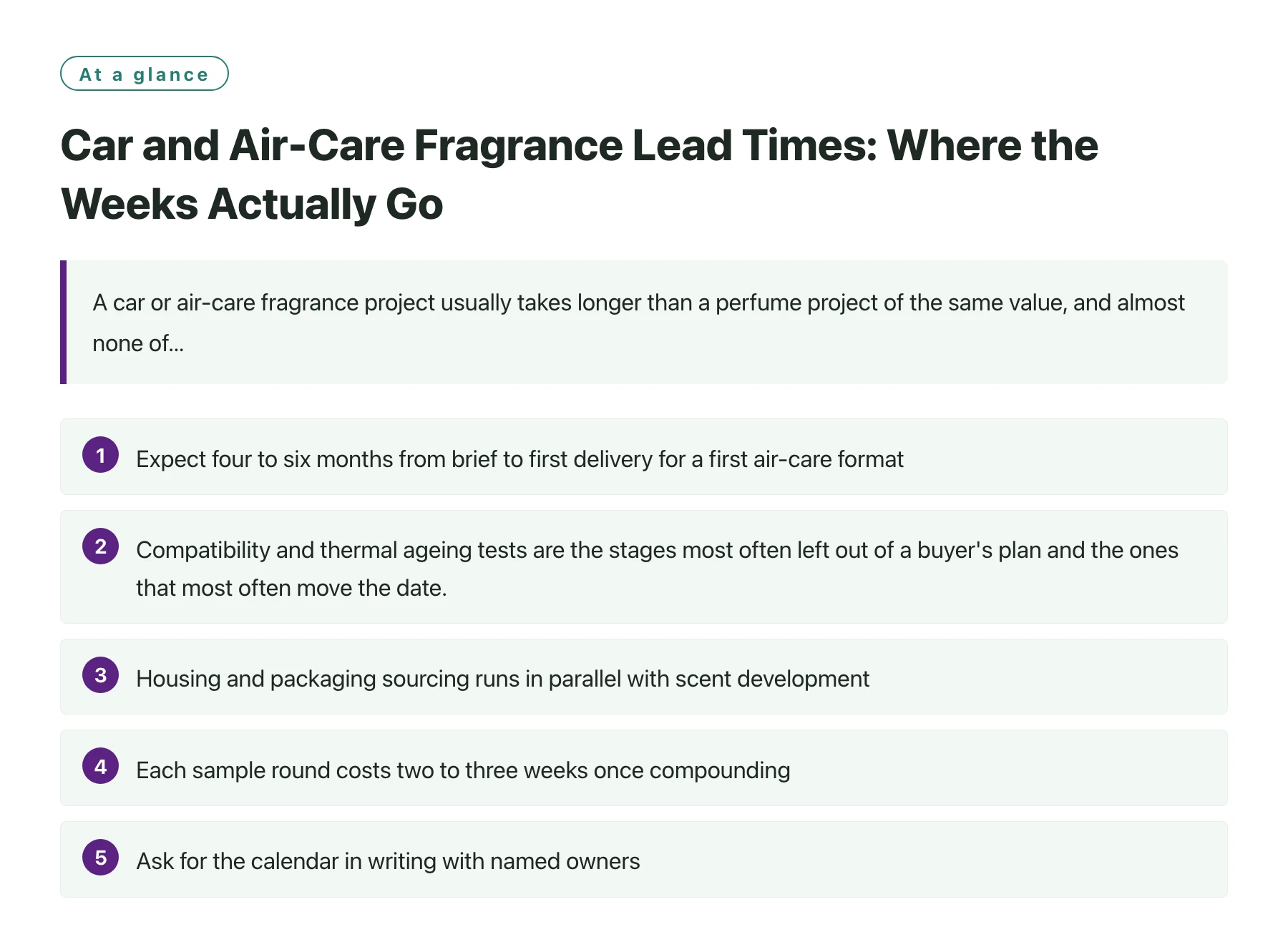
- Expect four to six months from brief to first delivery for a first air-care format, with the scent itself occupying only part of that.
- Compatibility and thermal ageing tests are the stages most often left out of a buyer's plan and the ones that most often move the date.
- Housing and packaging sourcing runs in parallel with scent development, so it must be started at the same time rather than after approval.
- Each sample round costs two to three weeks once compounding, shipping and evaluation are counted, which is why brief quality is a schedule decision.
- Ask for the calendar in writing with named owners, and treat any stage without a duration as an open risk rather than a detail.
Product development managers who move into air care for the first time are usually surprised by the same thing: the timeline is dominated by tasks that have nothing to do with the fragrance. Scent selection may take three weeks. Proving that the scent does not attack the housing, or that the reservoir does not leak after thermal cycling, can take longer than everything else combined.
This is a planning article rather than a technical one. It is written for a product development lead at a niche house who has to hand a realistic date to a founder, and it separates the stages that can be compressed from the ones that cannot.
The stages, and what each one is really waiting for
Brief, scope freeze and direction
The project starts with a scope freeze, not a brief. Format, housing, volume band, price band and market list have to be settled before development work is worth starting, because each of them changes the formula or the test plan. Teams that brief the scent before settling the housing usually re-brief within a month.
Direction work follows. A partner that develops rather than selects will propose one or two directions and explain the reasoning, and the stages of perfume production shows how that work sits inside the wider sequence. The useful question to ask is how many rounds are included before charges begin.
Sample rounds
A sample round is rarely a single week of work. Compounding, resting, filling into the actual housing, sending, and a proper evaluation usually add up to two to three weeks per round. Count two rounds as a floor and three as a plan, then note that the cost of an extra round is both money and three weeks.
Sample rounds are also the stage a buyer can genuinely compress, by writing a better brief. A brief that names the end use, the price tier and three reference products generates a usable sample earlier than a brief that describes an atmosphere.
Compatibility, thermal ageing and transport testing
This is where an air-care calendar diverges from a perfume calendar, and where the honest answer is that the work cannot be rushed. Ageing tests need elapsed time. Heat accelerates some reactions and changes others, so a supplier may run both an accelerated condition and a real-time condition. A category-specific restriction assessment belongs here too, because it can force a reformulation after the scent is otherwise approved [1].
Independent laboratory testing of consumer products follows a scope that has to be agreed in advance, and the queue for that work is part of the schedule rather than an exception to it [2]. Ask for the laboratory slot to be booked when the formula is frozen, not when the sample is approved.
Housing, packaging and bulk
Housing and packaging sourcing should run in parallel with scent development from week one. A standard vent clip housing and a custom moulded body have very different lead times, and decoration, printing or coating adds another sequence that starts after the component exists.
Bulk production and filling are comparatively predictable, and they are also the stages buyers overestimate. The risk sits upstream: if the housing arrives late, the filling slot moves, and the filling slot is often the hardest thing in the plan to reschedule.
A planning table for a first air-care order
| Stage | Planning range | What compresses it | What stretches it |
|---|---|---|---|
| Scope freeze and brief | 1 to 2 weeks | A written brief with format, volume, price band and market list. | A brief that changes after sampling has started. |
| Direction and scent selection | 2 to 3 weeks | Three clear reference products and a defined price tier. | Many directions explored at once, or no price constraint. |
| Sample rounds | 2 to 3 weeks each | Fewer, better-prepared rounds; a single decision-maker. | Slow internal tasting, late feedback, repeated re-briefing. |
| Application and thermal testing | 3 to 6 weeks | Testing against the final housing rather than a proxy pack. | A housing change after testing has begun. |
| Housing and packaging | 2 weeks to 3 months | Standard components and early sourcing. | Custom tooling, or decoration sequenced after approval. |
| Bulk, filling and release | 2 to 3 weeks | Reserving the filling slot in advance. | A missed component delivery, or a failed release test. |
| Delivery | 1 week to 5 weeks | Air freight for a small first run. | Sea freight, or transport classification discovered late. |
Add the ranges and a first order lands between roughly four and six months, with a custom housing pushing past that. The point of the table is not to fix a number but to force a conversation: ask your supplier to fill in the same columns for your project and compare.
Planning the calendar backwards without lying to yourself
Work backwards from the date that cannot move, the shelf date or the campaign date, and subtract each stage in order. Ask a fragrance manufacturer in Guangzhou to fill in the same table for your project, because the subtraction usually shows that the brief has to be complete before the brand has finished its own creative work, which is an uncomfortable but useful finding.
Then separate the stages by who owns them. Stages owned by the factory can be managed with a schedule; stages owned by the buyer, brief sign-off, internal tasting, artwork and claims, are the ones that slip quietly because nobody treats them as tasks with dates.
Where a partner handles development, testing and filling in one place, two of the handovers disappear and the plan gets shorter without any work being rushed. what one-stop scent development covers is a fair description of what that removes, and equally of what it cannot remove: elapsed testing time is elapsed testing time, whoever runs it.
Finally, look at the riskiest assumption in your own plan. If it is the housing, start it first. If it is the scent, budget an extra round. If it is the date, move the date rather than the tests, because a car fragrance that fails in a hot interior will cost more than a delayed launch, and no schedule survives a recall.
A supplier used to running both OEM and ODM work can usually tell you which of those risks has bitten it before. a manufacturer that supports OEM and ODM is worth reading not for the label but for the questions it suggests you ask about who owns each stage of the calendar.
Ask for the project calendar as a document with a duration, an owner and a dependency for every stage. A verbal timeline is a hope; a table with named owners is a plan you can hold someone to.
Sources
- IFRA Standards Library (International Fragrance Association) —— The IFRA Standards Library lists the restrictions the fragrance industry applies to individual fragrance ingredients, based on safety assessments; it is the reference point for compliant fragrance formulation.
- SGS: Cosmetics, Personal Care & Household Testing —— Testing, inspection and certification services for cosmetics and personal care, including microbiological, stability and safety testing aligned with cosmetics GMP.
Frequently asked questions
How long does a car fragrance order take from brief to delivery?
For a first order, plan four to six months. Scent development is a minority of that; compatibility testing, thermal ageing, housing sourcing and filling capacity account for most of the calendar.
Why does air care take longer than perfume?
Because the fragrance is part of a delivery system. The housing, metering element and airflow all have to be tested together, and those tests need elapsed time rather than effort.
Can we shorten the timeline by paying more?
Partly. Air freight, parallel sourcing and reserved filling capacity buy weeks. Compatibility and ageing tests do not respond to money, because the constraint is time rather than capacity.
When should housing sourcing start?
The same week as the brief. It is the stage with the widest range and the one most likely to sit on the critical path, especially with custom tooling or decoration.
What single question reveals whether a supplier's timeline is real?
Ask who owns each stage and what each stage is waiting for. A supplier with a real plan answers with dependencies; one without a plan answers with total weeks.