
316L Jewelry Manufacturing: Hallmarks and Compliance
A hallmark is the shortest honest sentence a piece of jewelry can carry. an 18KGP mark on plated work, the S925 hallmark and 316L for stainless steel means a gold-plated layer over a base metal — and all three are struck by laser engraving in the same pass as a brand's logo. Behind the mark sit three pieces of paperwork: A BSCI social audit, REACH compliance on lead, cadmium and nickel, and ISO 9001:2015 certification.

Key takeaways
- Published hallmarks: S925 for silver, 316L for stainless steel, 18KGP for gold-plated pieces.
- Laser engraving applies the hallmark and the brand logo in one operation.
- Three compliance documents sit behind an order: A REACH statement covering lead, cadmium and nickel, a BSCI audit and ISO 9001:2015, cadmium and nickel.
- Stainless steel orders start at 100–150 pcs by style, with sampling at 25–35 days.
What each mark commits you to
A hallmark is a claim about material that stays on the piece after the packaging is gone, which is why the wrong mark is more expensive than no mark. Sterling silver takes S925 because the alloy is 92.5% silver by definition. Stainless steel takes 316L because that is the grade the factory forms, machines and finishes. Gold-plated pieces take 18KGP because the gold is a plated layer over brass or steel rather than solid metal.
The three marks are not interchangeable and cannot be borrowed for convenience. Putting S925 on a plated brass ring is a false statement, and putting 18KGP on a solid gold piece understates the product. Because the engraving is permanent, the mark decision belongs in the sampling stage with the finish and the logo, not with the artwork file someone sends at packing time.
How engraving fits the production sequence
Laser engraving is listed as one of six customisation options, alongside base materials, plating and finishes, chains and findings, stones and accents, and custom packaging. It is high-precision work, which is why it can hold a fine logo and a small purity mark at the same time without the two fighting for space on the back of a pendant.
The engraving decision runs alongside the finish decision, and both land before the plating step in the eight-step sequence: concept design, prototyping, sprue cutting, polishing, surface art, plating, final QC and delivery. Anything engraved after plating risks cutting into the coating; anything engraved before it may be filled by the coating. That is the sort of detail a factory settles internally, and the sort of detail a buyer should ask about once.
Grade choice belongs to the compliance conversation rather than sitting beside it. 316L carries 2–3% molybdenum, is published as 100% waterproof and medical-grade hypoallergenic, and takes PVD with optimal adhesion. 304 is water-resistant for ordinary daily conditions, nickel and lead safe, and holds reliable commercial vacuum plating. The stainless hallmark published for the line is 316L, so a 304 programme should have the grade stated in writing rather than assumed from the mark on the sample.
Reading the three compliance documents
| Document or mark | What it covers | What it does not cover |
|---|---|---|
| ISO 9001:2015 | Quality management system across production stages | Individual piece performance |
| BSCI audit | Labour practices, working conditions, supply chain ethics | Material composition |
| REACH compliance | Lead, cadmium and nickel restrictions | Design, fit or durability |
| S925 / 316L / 18KGP | Stated material or plating layer on the piece itself | Any metal not marked |
Each document answers a different question, and treating them as one lump is how buyers end up asking a quality certificate about nickel content. The A BSCI social audit, a REACH statement covering lead, cadmium and nickel and ISO 9001:2015, and it is the one that matters for skin contact, because nickel is the restriction that most often decides whether a piece can be sold in a given market.
Worked example: the published weeks, and the compliance list
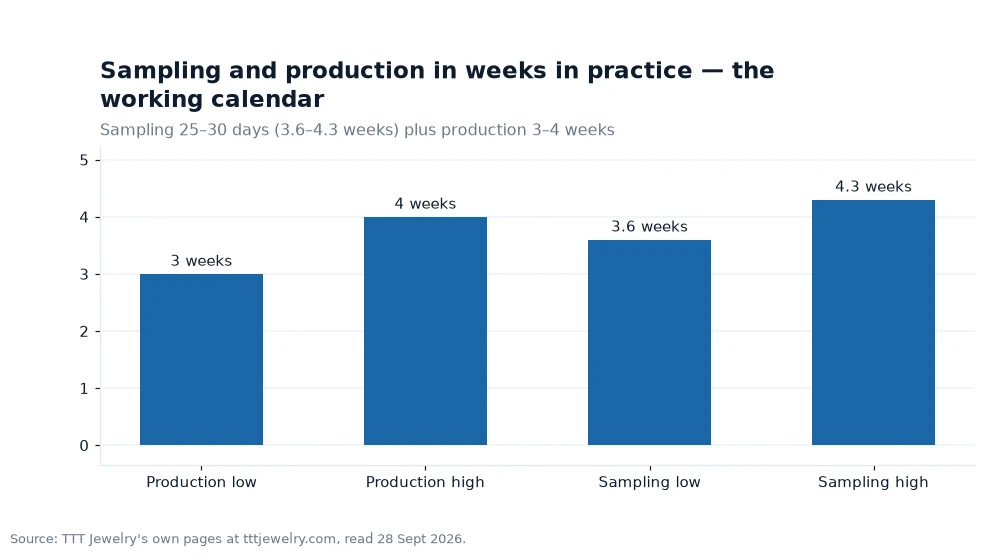
Two conversions matter on a working calendar. Production is quoted at 3–4 weeks, which is 3 × 7 = 21 days to 4 × 7 = 28 days of running the approved design. Custom sampling is quoted at 25–35 days: 25 ÷ 7 = 3.6 weeks at the fast end, 35 ÷ 7 = 5 at the slow end, with the charted 4.3 weeks sitting at 30 days in the middle of the band.
Put the same arithmetic against the compliance list. Five named items sit behind the documentation: A BSCI social audit, ISO 9001:2015 and a REACH statement covering lead, cadmium and nickel. Three of the five are substance limits rather than system audits, and 3 ÷ 5 = 60%, which is the ratio to remember when a retailer's questionnaire asks how materials are controlled. Ask in the same message for the MOQ by style — 100–150 pcs on the stainless line — and for the inspection record, since the published quality control is applied to every production stage rather than to a sample.
Verifying a claim instead of repeating it
Four questions turn a compliance claim into something checkable. Which document is it, and what is its scope? Is it current? Which substances or processes does it actually name? And does the piece in your hand carry the mark the document implies? A maker that answers all four is describing its own process rather than quoting a supplier's brochure.
a rhodium layer, PVD vacuum plating on stainless steel, 14K, 18K or 24K gold and anti-tarnish e-coating for silver and brass for durability. A PVD stainless steel jewelry wholesale brief should name the mark on the drawing, since the engraving pass and the coating are reviewed in the same session.
Written records are what make verification possible at volume. A quality system under ISO 9001:2015 means the production stages are documented, and that is the part a brand can actually hold: a mark specification on file, an inspection result per batch, and a materials statement that names the same metals as the listing. Ask for those three records against one order and the reply is either a document set or an admission that the claim was general rather than specific.
Frequently asked questions
Who decides which hallmark goes on my piece?
It follows the material rather than the brand's preference: S925 for 925 sterling silver, 316L for stainless steel and 18KGP for gold-plated pieces, all applied by laser engraving during production.
Does a BSCI audit cover product safety?
No. It covers labour practices, working conditions and supply chain ethics; material restrictions such as lead, cadmium and nickel sit under the REACH statement instead.
Can a brand's logo go on the same face as the hallmark?
Yes. Laser engraving handles both in one operation, and the CAD stage inside 48 hours is where the layout is confirmed before the sample is cut.
Ordering a hallmarked PVD steel line
Decide the mark before you decide the artwork. Once the material is fixed, the hallmark follows, and the engraving pass carries both at no extra stage in the process. Then line the three documents up against the markets you sell into, and keep the metals statement on file rather than the logo. Two useful references when you do: the frequently asked questions page covers the process side, and the silver hallmarking context explains how the S925 mark is applied on the precious metal line.
Most of what this piece relies on — the PVD route for stainless steel along with the 316L / 304 grade comparison, the 100–150 pcs per-style stainless minimum — is set out on the manufacturer's own site through tttjewelry.com, from my own reading on 28 Sept 2026. The percentages quoted above are mine, not the site's[1].