
Counting the Hours a Shed Mine Loses to the Grid
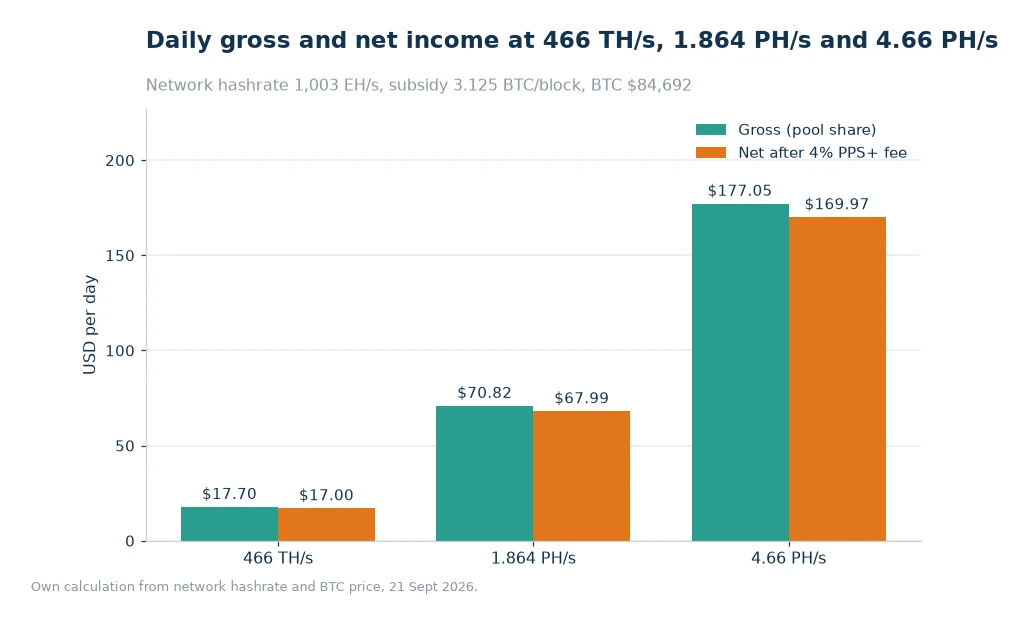
A shed at the end of a long service drop is a grid customer before it is a mining operation. At 466 TH/s the machine earns about 0.00020905 BTC a day, $17.70 gross at $84,692 and $17.00 after the listed 4% on the block-reward component. Twenty-one hours of lost running in a month is 0.00018290 BTC that never arrives, and nobody notices until the total is compared with the month before.
Key takeaways
- 466 TH/s is 0.00020905 BTC a day, or 0.00000871 BTC an hour.
- Six hours of lost cooling can cost more than the repair because the machine throttles first.
- Most outages are short; the pattern matters more than any single event.
- A restart checklist removes the second, self-inflicted outage after the power returns.
The building is part of the machine
Urban miners think about the pool. Shed miners think about the transformer. A single 466 TH/s unit at 20 J/TH pulls 9.32 kW, which is close to the capacity of a domestic service in many places and well beyond what a garden circuit was designed to carry. Add a fan, a light and a dehumidifier and the margin disappears.
Voltage sag is the quiet version of this problem. When the load draws harder than the drop can supply, the input voltage falls, the power supply works harder, and the machine may reset without ever tripping a breaker. The symptom looks like random reboots, and the cause is a cable that was never sized for the job.
None of that is a mining problem in the usual sense. It is a site problem, and the fix belongs to an electrician rather than to a firmware update.
It is worth measuring before assuming. A plug-in energy monitor left on the circuit for a week will show the real draw, the real voltage, and whether anything else in the building is competing for the same supply. Numbers from a meter beat numbers from a specification sheet, especially in an older building where the wiring has been extended twice.
Three kinds of stop, three different bills
The first is a hard stop: the machine is off and stays off until someone restarts it. The cost is the full hourly rate for every hour it is down, plus the travel time to reach it. This is the easiest to count and the easiest to alarm on.
The second is throttling. The machine is running, but the intake is hot or a fan is weak, so the firmware reduces clock speed to protect the boards. The hashrate falls without an outage, and the loss is a fraction of the hourly rate spread across many hours. It never triggers an offline alert, which is exactly why it is expensive.
The third is a network stop. The hardware is fine, the pool is fine, and the router has dropped the connection. Shares stop arriving while the machine draws full power. The cost is the credit, not the electricity, and the electricity is the part that hurts: you pay for work that was never submitted.
| Event | Hours lost | BTC not credited | USD at $84,692 |
|---|---|---|---|
| Blocked filter, throttled | 6 | 0.00005226 | $4.43 |
| Grid outage | 12 | 0.00010453 | $8.85 |
| Router dropped | 3 | 0.00002613 | $2.21 |
| Month total | 21 | 0.00018290 | $15.49 |
Twenty-one hours is 2.9% of a month, which sounds trivial until it is compared with the margin. If the unit clears a few dollars a day after power, three percent of output is a visible slice of the profit rather than a rounding error.
Worked example
Turn the daily rate into an hourly one, because outages are measured in hours.
- Cut the network's daily 450 BTC into terahashes: 450 ÷ 1,003,000,000 = 0.00000044865 BTC.
- 466 TH/s: 466 × 0.00000044865 = 0.00020905 BTC a day.
- Hourly: 0.00020905 ÷ 24 = 0.00000871 BTC.
- Gross dollars: 0.00020905 × 84,692 = $17.70. The listed 4% on the reward portion brings that to $17.00.
- Twelve hours off: 12 × 0.00000871 = 0.00010453 BTC, or $8.85.
- Six hours throttled to half rate: 6 × 0.00000436 = 0.00002613 BTC, about $2.21.
- Twenty-one hours at full stop: 0.00018290 BTC, or $15.49, which is 2.9% of the month.
The restart is longer than the outage
A twelve-hour grid failure is rarely followed by twelve hours of lost income. It is followed by a restart that takes anywhere from ten minutes to two days, depending on what the machine does when power returns. Firmware that boots into a safe mode, a pool URL that needs re-entry, a router that comes up after the miner and leaves it disconnected: each of these adds hours that the outage itself does not explain.
Write a restart order and tape it inside the shed. Power the router first, wait for the link light, then the machine, then confirm the worker is online and submitting. Three steps, in that order, remove most of the self-inflicted tail.
A small uninterruptible supply for the router alone is worth considering. It does not keep the miner running, but it keeps the network alive through a short dip, and it means the machine reconnects to a working pool connection rather than waiting for a modem to finish booting.
Test the checklist once on purpose. Trip the breaker on a quiet afternoon, then time how long it takes to get the worker back to full hashrate using only the note on the wall. Whatever is missing from the note will be obvious within minutes, and the test costs less than an hour of credits.
The Profit Calculator gives the day's expected value at the rated hashrate, which is the number the log should be compared with after a week.
Logging stops until a pattern appears
One outage is an event. Six outages in a month are a pattern, and the pattern usually has a single cause: a breaker that trips at the same load, a fan that stalls when the ambient temperature passes a threshold, a neighbor's equipment that draws on the same phase. None of these are visible from a single incident.
Keep a simple log with four columns: date, start time, end time, suspected cause. After a month, read it as a list rather than as individual entries. The pool state page helps separate site problems from pool problems, because it shows whether the pool was accepting shares while your worker was silent.
Alerts make the log possible. A hashrate alarm that fires when the worker drops, and a share-age alarm that fires when the connection stalls, produce timestamps you would otherwise reconstruct from memory. The ViaBTC App Download installation on a phone in the house gives you both, and the notification history becomes the first draft of the log.
Frequently asked questions
How much does one hour of downtime cost at 466 TH/s?
About 0.00000871 BTC, which is $0.74 gross at $84,692 and roughly $0.71 after the listed 4% on the block-reward component.
What is the most common cause of a shed outage?
Power delivery and cooling usually lead: a tripped breaker, a voltage sag on a long service drop, or a blocked filter that forces the machine to throttle.
Should I keep mining through short grid outages?
There is nothing to decide during the outage; the useful work is a restart order and a log, so the machine returns to full rate quickly and the next event is easier to diagnose.
Fix the site before the schedule
Ask an electrician to measure the voltage at the machine under full load, not at the panel with everything idle. If it sags more than a few percent, the cable or the drop is undersized, and no amount of monitoring will fix that. It is the least glamorous item on the list and often the one that pays for itself first.
Then clean the intake, check the fan bearings by hand, and write the restart order. The Statistics view gives the pool-side figures to compare against, so a quiet week can be attributed to the site rather than guessed at.
Sources: ViaBTC pool state, statistics and app pages for share data and monitoring[1]. Site figures assume 20 J/TH; chain and price inputs read 21 Sept 2026 (1,003 EH/s, 132.76 T, 3.125 BTC, 144 blocks daily, $84,692). Published 24 Oct 2026.